
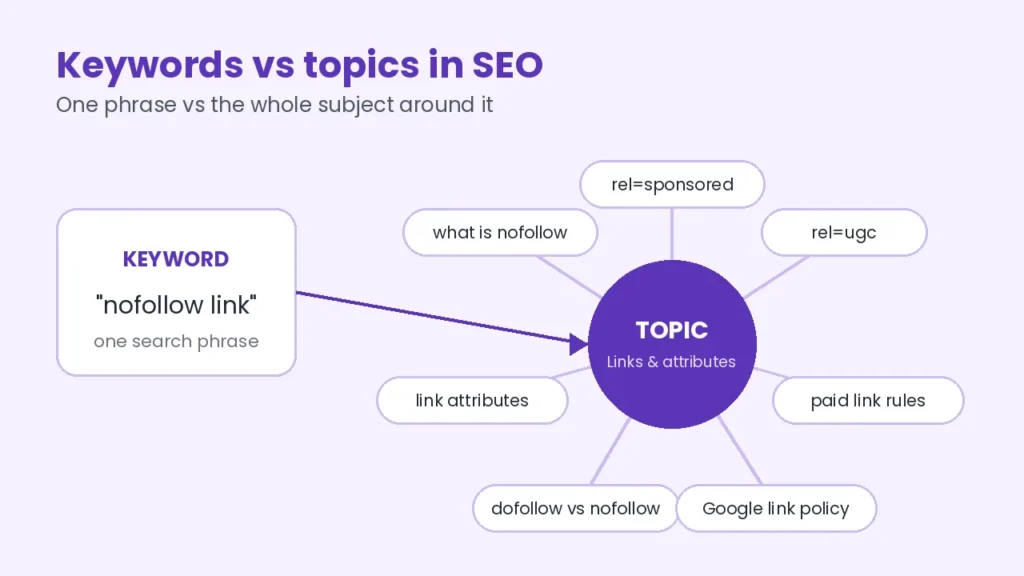
When people compare keywords vs topics in SEO, they usually want to know which one to plan content around. The short answer is both, in a specific order: topics decide what you cover, and keywords decide how you phrase and label each page. A keyword is a phrase people type or say into a search engine. A topic is the whole subject area that phrase belongs to, including the related questions, terms and subtopics a reader expects you to cover.
Quick answer: Keywords are individual search phrases used to target and measure a single page. Topics are broader subject areas covered by a group of connected pages. Modern search engines evaluate whether you cover a subject thoroughly, so plan by topic first, then assign one primary keyword to each page inside it.
Key takeaways
- Keywords tell you what people type. Topics tell you what people are trying to understand or do.
- One page should have one primary keyword but should cover the full topic around it.
- Topic clusters help both rankings and AI answers because they show depth, not just repetition.
- The most common failure is two pages competing for the same keyword. It is fixable in under an hour.
What is a keyword in SEO?
A keyword is the word or phrase a person enters into a search engine. “Nofollow link definition”, “best running shoes for flat feet” and “how to fix a leaking tap” are all keywords. Marketers measure them with three simple attributes: search volume (how often the phrase is searched), difficulty (how hard it is to rank) and intent (what the searcher wants).
Keywords are still useful. They tell you the exact language your audience uses, they let you check whether a page is bringing impressions and clicks, and they give each page a clear focus.
What is a topic in SEO?
A topic is the subject a group of related keywords belongs to. “Link attributes” is a topic. Under it sit many keywords: “what is a nofollow link”, “rel sponsored vs ugc”, “do nofollow links help SEO” and “how to add nofollow in WordPress”. A reader who searches any one of them is likely to want answers to several of the others.
Topic thinking asks a different question. Instead of “which phrase should this page rank for?” it asks “if someone wanted to fully understand this subject, what would they need from us?”
Keywords vs topics: side-by-side comparison
| Keyword | Topic | |
|---|---|---|
| Definition | A specific search phrase | A subject area made of many related phrases |
| Scope | One page | A group of connected pages |
| Example | “seo directory structure” | Site architecture and URLs |
| Main use | Targeting, titles, measurement | Planning coverage, depth and internal links |
| Typical mistake | Repeating the phrase too often | Covering the subject too thinly |
| Measured in | Rankings, clicks for one query | Combined clicks across a cluster |
Why search moved from keywords to topics
Early search engines matched the words in a query to the words on a page, so repeating a phrase worked. Google’s Hummingbird update in 2013 shifted towards understanding the meaning of a whole query, and later language models such as BERT (2019) improved how well search handles natural phrasing and context. Today’s AI-generated answers go further by combining information from several pages into one response.
The practical effect is that a page can rank for hundreds of phrases it never mentions word for word, as long as it covers the subject well. Google’s guidance on helpful, reliable, people-first content makes the same point from the content side: write to satisfy the reader’s need, not to match a phrase.
Search intent: the bridge between keywords and topics
Intent explains why two similar keywords can need different pages. The four common types are:
- Informational: “what is anchor text” (the searcher wants to learn).
- Commercial investigation: “best backlink checker” (comparing options).
- Transactional: “buy guest post” (ready to act).
- Navigational: “Google Search Console login” (looking for a specific site).
Before you assign a keyword, search it and look at the page types ranking. If every result is a how-to guide, a product page will struggle, however well optimised it is.
How to plan content using both: a step-by-step method
Step 1: List your core topics
Write five to ten subjects your customers need help with, in plain language. For a link-building marketplace these might be backlink basics, link attributes, indexing and guest posts. Choose topics where you have real experience, because that is where you can add something others do not.
Step 2: Collect the keywords under each topic
Use free sources first: Google autocomplete, the People Also Ask box, related searches and the Queries report in Search Console. Paid tools add volume and difficulty estimates, but the free sources show you real language. Our guide to learning SEO by yourself has a free routine for this.
Step 3: Group keywords by intent
Put phrases that need the same answer together, and separate those that need a different kind of page. “Nofollow link definition” and “what is a nofollow link” belong on one page. “Buy nofollow links” is a different intent and a different page.
Step 4: Assign one primary keyword per page
Create a simple sheet with columns for page URL, primary keyword, secondary keywords and intent. The primary keyword goes in the title, the first paragraph, one heading and the URL. Secondary keywords appear naturally where they help the reader.
Step 5: Build a pillar page and supporting cluster pages
A pillar page gives a broad overview of the topic. Cluster pages go deep on individual questions. Each cluster page links up to the pillar and across to related cluster pages. See our guide on internal linking for SEO for how to do this without creating orphan pages.
Step 6: Write each page to answer, not to repeat
Open with a direct answer in two or three sentences, then expand. Include definitions, steps, examples and a short FAQ. Add the related terms a knowledgeable person would naturally mention.
Step 7: Measure at topic level
In Search Console, filter by a page folder or by a query pattern and look at total clicks and impressions for the cluster over time. A rise across the cluster tells you more than a single keyword moving up one position.
Worked example: one topic, several keywords
Take the topic “link attributes”. A tidy cluster could look like this:
| Page role | Primary keyword | Intent |
|---|---|---|
| Pillar | link attributes in SEO | Informational, broad |
| Cluster 1 | nofollow link definition | Informational |
| Cluster 2 | rel sponsored vs rel ugc | Informational, comparison |
| Cluster 3 | dofollow vs nofollow links for buyers | Commercial investigation |
| Cluster 4 | how to add nofollow in WordPress | Informational, how-to |
The buyer-focused page already exists on this site: Dofollow or Nofollow: What Should You Buy? New pages should link to it and be linked from it.
Five common problems and how to fix them
Problem 1: Two pages compete for the same keyword (cannibalisation)
How to spot it: In Search Console, open Performance, click a query, then switch to the Pages tab. If two URLs both receive impressions for the same query and their positions swap week to week, they are competing.
Fix: Decide which page deserves the keyword. Merge the weaker page’s useful content into the stronger one, redirect the old URL with a 301, and update internal links. If both pages serve genuinely different intents, rewrite the titles and headings so each clearly targets its own phrase.
Problem 2: Keyword stuffing
How to spot it: Read the page aloud. If the phrase appears in nearly every sentence, it is stuffed.
Fix: Keep the exact phrase in the title, first paragraph, one subheading and the conclusion. Replace the rest with synonyms and related terms, and focus on answering the question completely.
Problem 3: Chasing high volume and ignoring intent
Fix: Filter your list for relevance first, volume second. A phrase with a few hundred monthly searches from people who could become customers is worth more than a phrase with tens of thousands from people who never will.
Problem 4: A topic covered by one thin page
Fix: List the questions a beginner and an expert would each ask. If your page answers fewer than half, expand it or add supporting pages. Check the People Also Ask box and the pages currently ranking to find gaps.
Problem 5: Cluster pages nobody can find
Fix: Make sure every cluster page is linked from the pillar and from at least two related pages, using descriptive anchor text. Our guide on anchor text in SEO explains how to word those links.
Keywords, topics, E-E-A-T, AEO and GEO
Topic-based planning supports the three ideas shaping search content in 2026.
- E-E-A-T (Experience, Expertise, Authoritativeness, Trustworthiness) is easier to show across a connected set of pages than on one isolated article. Add author names, short bios, review dates and references. Show real experience through screenshots, examples and lessons only someone who has done the work would know.
- AEO (Answer Engine Optimisation) means giving a clear, direct answer early in the page. Use question-style subheadings, short definitions and brief lists, which are easy for search features and assistants to lift.
- GEO (Generative Engine Optimisation) means making your content easy for AI systems to understand and cite. Name things consistently, define terms once, include verifiable facts with sources, and keep each page about one clearly stated subject. Google says that its AI features rely on the same foundations as normal Search, so there is no separate trick.
Free tools for keyword and topic research
- Google Search Console: shows the real queries and pages bringing impressions.
- Google autocomplete and People Also Ask: reveal natural phrasing and related questions.
- Google Trends: compares interest between phrases over time.
- A simple spreadsheet: the keyword-to-page map is the most valuable tool of all.
For paid options, see our overview of the top 5 SEO tools.
Frequently asked questions about keywords vs topics in SEO
Are keywords still important in SEO?
Yes. They show the language your audience uses and help you target and measure pages. They matter less as a repeated phrase and more as a label for what each page answers.
What is the difference between a keyword and a topic?
A keyword is one search phrase. A topic is the wider subject that includes many related phrases, questions and subtopics.
How many keywords should one page target?
One primary keyword and a handful of closely related secondary phrases that share the same intent. Do not combine different intents on one page.
What is a topic cluster?
A topic cluster is a pillar page on a broad subject plus several detailed supporting pages, all linked together so readers and search engines can see how they relate.
Do topics help with AI search?
They help because AI answers draw on pages that clearly cover a subject. Consistent terminology, direct answers and credible sources make your content easier to use and cite.
Conclusion: plan by topic, label by keyword
The debate over keywords vs topics in SEO is really about order. Decide which subjects you want to be known for, find the phrases your audience uses inside each one, give every page a single primary keyword, and connect the pages with clear internal links. That structure is easier to maintain, easier to measure and easier for both search engines and AI answers to trust.