
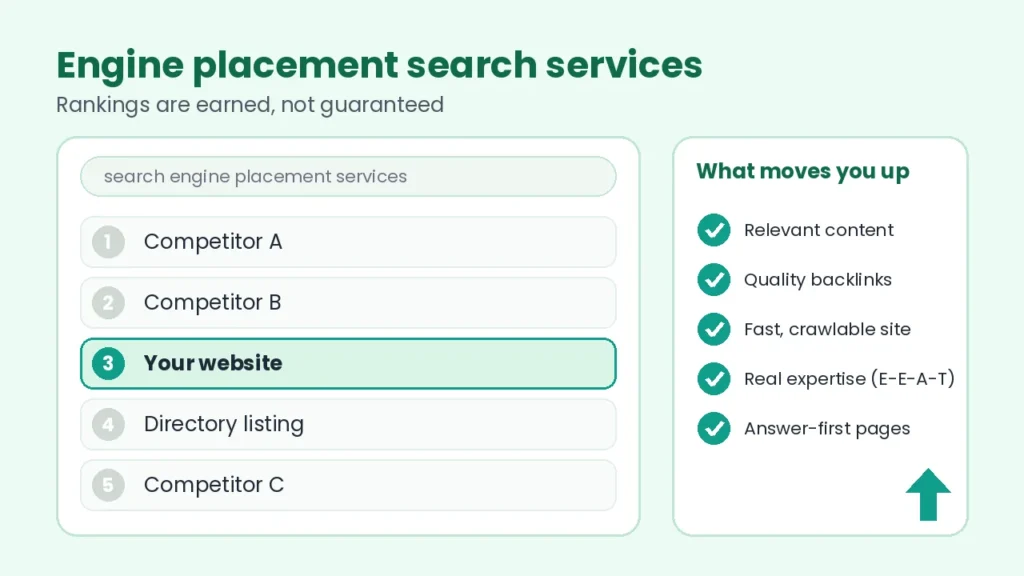
Engine placement search services, more commonly called search engine placement services, are paid offers that promise to get your website listed, indexed and ranked in search results. Some of what they sell is genuinely useful: technical fixes, content, links and local listings. Some of it is outdated or misleading, such as “submission to hundreds of search engines” and guaranteed first-page placement. This guide explains what these services really do, what no provider can promise, how to get listed yourself for free, and how to tell a legitimate provider from a scam.
Quick answer: Engine placement search services combine search engine submission, on-page and technical SEO, content, link building, directory or local listings and sometimes paid ads. Submission alone is rarely needed, because Google and Bing find sites through links and sitemaps. No one can guarantee a position, because rankings depend on relevance, quality and competition that no vendor controls.
Key takeaways
- Getting indexed is free. Google Search Console and Bing Webmaster Tools do it at no cost.
- Ranking well is the hard part, and it comes from useful pages, a healthy site and earned trust.
- Any promise of a guaranteed rank, or a “secret relationship” with a search engine, is a warning sign.
- Ask for a written scope, ownership of your accounts and outcomes you can verify yourself.
What are engine placement search services?
The label dates back to the early web, when you submitted your address to each search engine manually and hoped to be listed. Providers sold “placement” as a bundle of submissions and keyword tags. Today the label survives as a catch-all for anything that affects where and whether your pages appear in search results. When someone offers you engine placement search services, they may be selling any mix of the following.
| Service | What it is | Do you need to pay? |
|---|---|---|
| Search engine submission | Telling engines your site exists, usually via a sitemap | No. Free in Search Console and Bing Webmaster Tools |
| Technical SEO | Making pages crawlable, fast and indexable | Sometimes, if the site is complex |
| On-page SEO and content | Titles, headings, copy, structure that match what people search for | Often worthwhile |
| Link building | Earning links from relevant sites | Often worthwhile, if done safely |
| Local and directory listings | Google Business Profile, relevant industry directories | Profile is free; paid directories vary |
| Paid placement | Ads shown for chosen searches | Yes, by definition |
What engine placement search services cannot do
- Guarantee a ranking. Google’s own guidance on hiring an SEO says that no one can guarantee a top spot. See Google’s page on whether you need an SEO professional.
- Buy organic placement. Organic rankings cannot be purchased. Ads are labelled and billed separately.
- Submit you to “thousands of search engines”. Most traffic comes from a handful of engines, and they find sites without paid submission.
- Replace a useful website. A thin, slow or unclear site will not hold a position however it is promoted.
How to get your site placed in search results yourself (free, step by step)
Step 1: Verify your site in Google Search Console
Add your domain as a property and verify ownership through DNS or another offered method. This gives you indexing reports, search performance data and security alerts. It is also the account a provider should never own on your behalf.
Step 2: Submit an XML sitemap
Most content management systems generate a sitemap automatically, often at /sitemap.xml or /sitemap_index.xml. Submit its address under Sitemaps in Search Console. A sitemap helps discovery but does not guarantee indexing.
Step 3: Inspect and request indexing for your key pages
Paste an important URL into the URL Inspection tool. If it says the page is not on Google, check for problems and click Request Indexing. Do this for your homepage, main service pages and best content rather than for every URL.
Step 4: Set up Bing Webmaster Tools
You can import your site from Search Console. Bing also supports the IndexNow protocol, which lets your site notify participating engines when pages change. Google does not use IndexNow, so keep Search Console as your primary channel for Google.
Step 5: Remove anything blocking crawlers
Check that robots.txt does not block important folders, that pages do not carry an accidental noindex tag, and that canonical tags point to the right address. A site left in “discourage search engines” mode after development is a surprisingly common cause of invisibility.
Step 6: Make each page answer a real question
Give every important page one clear purpose, a descriptive title and a direct answer near the top. Pages that satisfy a search better than competing results earn placement. Our SEO tips for 2026 cover this in more detail.
Step 7: Earn links and mentions from relevant sites
Links are one of the ways search engines discover pages and judge trust. Start with partners, suppliers, local organisations and publications in your field. For safe methods, read how to get high-quality backlinks for free and whether backlinks still matter in 2026.
Step 8: Claim your local profile if you serve a local area
A complete Google Business Profile with accurate name, address, phone number, categories and photos is the most direct route into local results and map listings.
Step 9: Track, then repeat
Check the Indexing and Performance reports monthly. Note which pages are indexed, which queries bring impressions and where clicks are lagging. Adjust titles, content and links accordingly.
Common problems and how to fix them
Problem 1: My site does not appear in Google at all
Fix: Search for your domain in quotes. If nothing returns, verify the site in Search Console and run URL Inspection on the homepage. Look for a noindex tag, a robots.txt block, a password protection layer or a CMS setting that discourages search engines. New sites can take days or weeks to appear, so also make sure at least one existing site links to you.
Problem 2: Search Console says “Discovered, currently not indexed”
Fix: The engine knows the URL but has not crawled it yet. Improve internal links to the page, make sure it is in your sitemap, and check that your server responds quickly. Avoid flooding the site with low-value pages, since that competes for crawl attention.
Problem 3: “Crawled, currently not indexed”
Fix: The page was seen and judged not worth adding yet. Strengthen it with original information, clearer structure, better internal links and, where appropriate, links from other sites. Then request indexing again. Our guides on guest posts that are not indexed and getting backlinks indexed faster walk through safe methods.
Problem 4: Indexed, but on page five
Fix: Compare your page with the top three results for the same query. Note what they cover that you do not, how current they are and how many reputable sites link to them. Close those gaps before spending on promotion.
Problem 5: Rankings dropped after a provider “placed” you
Fix: Ask for a list of every link or listing created. Review them in Search Console and a backlink tool, and remove or disavow only those that are clearly manipulative. See toxic backlinks and when to disavow before taking action, because disavowing good links can do harm.
Problem 6: The snippet shows the wrong title or description
Fix: Write a unique, accurate title and meta description for each page. Search engines may still rewrite them, but clear on-page headings make a better rewrite more likely.
How to evaluate an engine placement search services provider
- Ask what exactly they will do each month. Look for specific tasks, not vague “optimisation”.
- Ask who owns the accounts. Search Console, Analytics and ad accounts must be in your name.
- Request examples of past work you can check. Live pages and verifiable results beat screenshots.
- Ask how they build links. You should be able to see where links are placed and why those sites are relevant.
- Agree on measures you can verify. Indexed pages, impressions, clicks and leads from Search Console and Analytics.
- Read the exit terms. Know what you keep if you cancel.
Red flags and common scams
- Unsolicited emails saying your site “is not on page one” or “has not been submitted”. These are mass-mailed templates.
- “Guaranteed number one” claims or a fixed delivery date for a top ranking.
- “Submission to 500+ search engines”. This is an outdated product with little value.
- Claims of a special relationship with Google. Google does not sell organic placement.
- Refusal to explain methods or to give you account access.
- Very cheap link packages with no detail about where the links appear. For safer buying, read how to buy guest posts in 2026.
How long does placement take?
Indexing of a healthy new page can happen within days, but it can also take weeks. Ranking for competitive phrases usually takes months of consistent work, and some phrases will remain out of reach. Links also need time to be discovered and to have an effect, as explained in how long backlinks take to work. Treat any provider promising results in days with caution.
Placement in the age of E-E-A-T, AEO and GEO
Being placed no longer means only a blue link. Search results now include AI-generated summaries, featured answers and local packs. Three ideas help you appear across them.
- E-E-A-T: show Experience, Expertise, Authoritativeness and Trustworthiness with named authors, real examples, clear contact details, reviews and cited sources. It is a quality framework from Google’s evaluator guidelines, not a switch you can turn on.
- AEO (Answer Engine Optimisation): give a direct answer in the first few sentences, use question-style headings and add a short FAQ.
- GEO (Generative Engine Optimisation): keep terminology consistent, state facts that can be verified, and make each page about one subject so AI systems can summarise and cite it accurately. Google’s page on AI features and your website says standard SEO best practices apply.
Frequently asked questions about engine placement search services
What are engine placement search services?
They are services that aim to get a website listed and ranked in search results. They may include submission, technical and on-page SEO, content, link building, directory listings and paid ads.
Do I need to submit my website to search engines?
Not usually. Search engines discover sites through links. Submitting a sitemap in Google Search Console and Bing Webmaster Tools is free and speeds up discovery.
Can anyone guarantee first-page placement?
No. Rankings depend on many factors that change continuously. A guarantee usually means a misleading promise or a very narrow, low-value keyword.
How much should I pay for placement services?
Prices vary widely. Instead of comparing price alone, compare scope: what tasks are included, what you will own at the end and how results are measured. Get this in writing.
Is paid placement the same as SEO?
No. Paid placement means advertising, where you pay for clicks or impressions and results stop when the budget stops. SEO builds organic visibility that continues without per-click fees.
Why is my new website not showing in search results?
Common causes are a noindex setting, a robots.txt block, no links pointing to the site, or simply not enough time. Verify the site in Search Console and use URL Inspection to see the exact status.
Conclusion: pay for work, not promises
Engine placement search services can help when they deliver real technical, content and link work that you can inspect. They cannot sell you a guaranteed position. Start with the free steps, keep ownership of your accounts, and judge every provider by evidence you can check yourself. If links are your next step, see how Markwood works to understand how guest post placements are selected and delivered.