
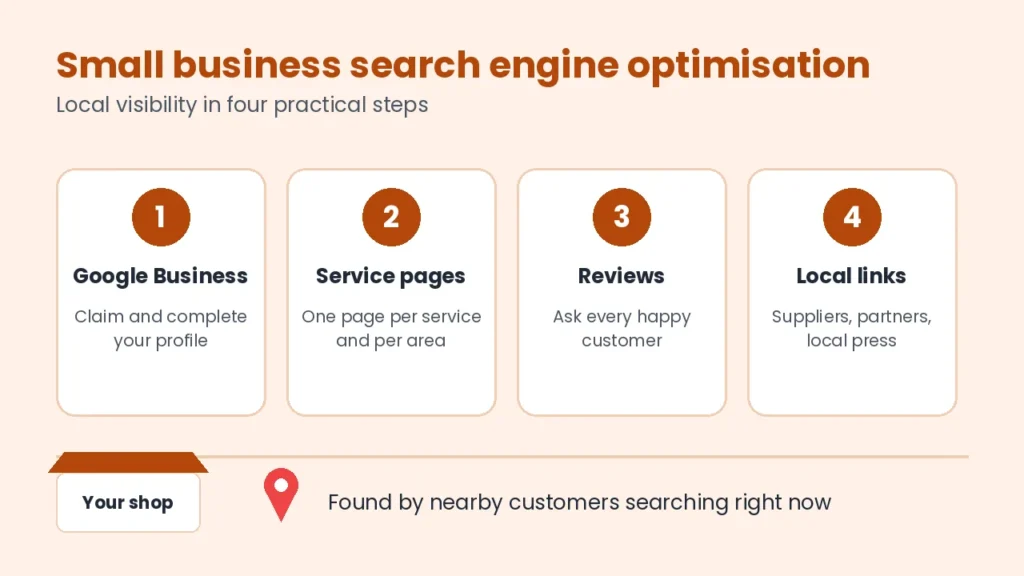
Small business search engine optimisation is the practice of making your business easy to find when people nearby, or people who need exactly what you sell, search on Google, Bing and increasingly on AI assistants. You do not need a large budget to do it well. You need a clear offer, an accurate Google Business Profile, pages that answer real customer questions, genuine reviews and a few trustworthy links. This guide gives you a practical 10-step plan, a 90-day schedule, fixes for the problems small businesses meet most often, and advice on when to hire help.
Quick answer: For a small business, SEO means claiming and completing your Google Business Profile, building one useful page per service and location, collecting honest reviews, keeping your business details consistent across the web, earning a few relevant local links and tracking leads in Google Search Console and Analytics. Most small sites can do the essentials themselves in a few hours a week.
Key takeaways
- Local results are driven by relevance, distance and prominence, according to Google. You can influence two of the three.
- One strong page per service beats one vague page listing everything.
- Reviews, accurate details and real photos build the trust that both customers and search systems look for.
- Track enquiries, not just rankings. Calls, form fills and direction requests are what pay the bills.
Why SEO matters for a small business
When someone searches for a plumber, an accountant or a bakery, they usually act quickly and choose from the first few results. If you are not among them, you do not exist at that moment. Unlike ads, organic visibility does not stop when you stop paying, and the work you do on your pages, profile and reputation keeps compounding. For businesses with a limited budget it can be one of the most cost-effective channels, provided you are realistic about timing. Early improvements in local listings can appear within weeks, while organic rankings for competitive phrases often take months.
Local SEO vs general SEO
| Local SEO | General (national) SEO | |
|---|---|---|
| Goal | Be found by nearby customers | Be found by anyone searching a topic |
| Main surfaces | Map pack, Business Profile, local organic results | Organic results, featured answers |
| Key assets | Business Profile, reviews, location pages, local links | Content depth, topical authority, links |
| Best for | Shops, trades, clinics, restaurants, service areas | Online shops, publishers, software, advice |
Many small businesses need both: local SEO to win nearby customers, and helpful content to attract people who are researching before they buy.
The 10-step small business SEO plan
Step 1: Define your customers, services and service area
Write down the three services that earn you the most profit, the types of customer who buy them and the places you actually serve. Search should support your business plan, not the other way round. If a service is not profitable, it does not need a page.
Step 2: Claim and complete your Google Business Profile
Search for your business, claim the profile and verify it. Then complete everything:
- Exact business name, as used in the real world, with no keywords stuffed in.
- Primary category (the most important choice) and relevant secondary categories.
- Address or service area, phone number, website and opening hours, including holiday hours.
- Services or products with descriptions, plus real photos of your premises, team and work.
- A short, accurate description of what you do and who you serve.
Google’s page on improving your local ranking explains that relevance, distance and prominence are the factors it uses. A complete, accurate profile supports relevance directly.
Step 3: Research the words your customers use
Start with Google autocomplete, People Also Ask and the Queries report in Search Console. Combine a service with a place and a need, such as “emergency plumber in [town]” or “gluten-free birthday cakes near me”. Aim for phrases that show buying intent, not only broad terms. Our guide to keywords vs topics in SEO shows how to group them, and learning SEO by yourself has a free routine.
Step 4: Build one page per service (and per location if you have several)
Each service page should answer the questions a buyer asks: what you do, who it is for, how it works, what it costs or how pricing is set, how long it takes, where you work, proof that you are good at it and how to get in touch. Add real photos, customer quotes and a clear call to action. Avoid creating dozens of near-identical “service in [town]” pages with only the place name changed, because they add little value.
Step 5: Get the on-page basics right
- A unique, descriptive title for each page that includes the service and place.
- One clear H1, with subheadings that follow real questions.
- Your name, address and phone number visible on the site and matching your profile.
- Descriptive alt text on images that explains what the photo shows.
- Links from related pages. See internal linking for SEO, and plan your URLs using our guide to SEO directory structure.
Step 6: Fix technical essentials
Check that your site uses HTTPS, works well on a phone, loads quickly and can be crawled. Connect Google Search Console, submit your sitemap and review the Pages report for problems. Pay attention to Core Web Vitals: loading speed (LCP), responsiveness (INP) and layout stability (CLS). A slow, awkward mobile site loses customers before they read a word.
Step 7: Publish helpful content that answers real questions
Turn the questions your customers ask by phone, email and in person into short, practical articles or FAQ entries: costs, comparisons, how to choose, what to do before a visit. Include your own experience, such as photos of jobs, simple checklists and lessons from past customers. This is what separates useful pages from generic ones.
Step 8: Earn honest reviews
Ask every satisfied customer, ideally right after a good experience, with a direct link to your review page. Reply to every review, positive or negative, politely and specifically. Never buy reviews, write your own or offer rewards in exchange for them, since that breaks Google’s policies and can get your listing penalised.
Step 9: Keep your details consistent and earn a few local links
List your business on the main directories relevant to your industry and area, and make sure the name, address and phone number match everywhere. Then seek links from sources that already know you: suppliers, trade bodies, chambers of commerce, local sponsorships, community pages and local news. Read how to get high-quality backlinks for free for safe methods, and how many backlinks you need to rank to set expectations. A handful of relevant links is far more useful than hundreds of random ones.
Step 10: Track what matters and adjust monthly
Each month, record Business Profile calls, direction requests and website clicks, Search Console clicks and impressions for your main pages, and the number of enquiries and sales that came from search. Ask new customers how they found you. If something is rising, do more of it. If nothing changes after a few months, review the page and the competition.
A 90-day schedule for a busy owner
| Period | Focus | Outputs |
|---|---|---|
| Days 1 to 14 | Foundations | Business Profile completed, Search Console and Analytics connected, top three services defined |
| Days 15 to 45 | Core pages | One page per main service, titles and headings fixed, mobile speed checked |
| Days 46 to 75 | Trust and content | Review request routine started, three helpful articles or FAQs published, directory details aligned |
| Days 76 to 90 | Links and review | Five relevant local link requests sent, results compared to baseline, next quarter planned |
Common small business SEO problems and how to fix them
Problem 1: You do not appear when you search your own business name
Fix: Check that the site is indexed using the URL Inspection tool in Search Console. Make sure noindex tags are not present and robots.txt is not blocking the site. Verify and claim your Business Profile, and link to the site from it.
Problem 2: You appear in the map but not in regular results, or the reverse
Fix: They use partly different signals. For the map, strengthen your profile, categories, reviews and proximity-relevant details. For organic results, improve the service page: content depth, clear headings, internal links and a few relevant external links.
Problem 3: Visitors arrive but nobody contacts you
Fix: Put a click-to-call button and a short form above the fold on mobile, show prices or price ranges where possible, add reviews and photos of real work, and remove distractions. Test the journey on your own phone.
Problem 4: Duplicate or outdated listings confuse customers
Fix: Search for old addresses and phone numbers. Merge or remove duplicates in the platform’s tools, update directories and correct your website footer. Keep a spreadsheet of every listing so changes are quick next time.
Problem 5: A competitor has more reviews
Fix: Build a routine instead of trying to catch up in a week: a card with a QR code at the counter, a follow-up text or email after each job, and a simple script for asking. Quality and recency matter as much as the count.
Problem 6: The site is slow or awkward on mobile
Fix: Compress and resize images, remove unused plugins, use a modern theme and enable caching. Retest key pages with a free speed tool and revisit the Core Web Vitals report in Search Console.
Problem 7: You have no time
Fix: Do the smallest valuable thing weekly. A realistic routine is 30 minutes to answer reviews, 30 minutes to improve one page and 30 minutes to send one outreach message or publish one photo update. Consistency beats occasional bursts.
How E-E-A-T, AEO and GEO apply to a small business
- E-E-A-T (Experience, Expertise, Authoritativeness, Trustworthiness): small businesses have a natural advantage in the Experience part. Show real people, real projects, licences or certifications, genuine reviews and clear contact details. Name the author or the owner on guides and explain their background.
- AEO (Answer Engine Optimisation): write short, direct answers to the questions customers ask, and place them near the top of the page or in an FAQ section. Questions such as “How much does X cost?” and “How long does X take?” are good candidates.
- GEO (Generative Engine Optimisation): AI-generated answers draw on pages and listings they can understand and trust. Keep your business name, services and details identical across your website, profile and directories, describe what you do in plain language, and earn mentions from reputable local sources. Google confirms in its guidance on AI features and your website that ordinary SEO foundations apply, so no special tricks are needed.
DIY, freelancer or agency?
| Option | Best when | Watch out for |
|---|---|---|
| Do it yourself | Budget is tight and you have a few hours a week | Inconsistency and slow progress |
| Freelancer | You want flexible, hands-on help with defined tasks | Unclear scope, single point of failure |
| Agency | You have multiple locations or a larger budget | Long contracts, generic reports, account ownership |
Whoever you choose, keep ownership of your Business Profile, Search Console, Analytics and domain. Be wary of guaranteed rankings, secret methods and unexplained link packages. Our guides to SEO software services and engine placement search services explain what to ask and what to avoid. For free tools to start with, see the free SEO checker roundup.
Mistakes to avoid
- Stuffing keywords into your business name on your profile.
- Using a virtual office or fake address to appear local.
- Buying cheap links or reviews.
- Copying competitor text or using generic, unreviewed AI copy that adds no experience.
- Ignoring mobile users.
- Measuring only rankings and not enquiries.
Frequently asked questions about small business search engine optimisation
What is small business search engine optimisation?
It is the process of improving a small business’s visibility in search results through a complete business profile, useful website pages, reviews, local citations, links and technical health.
How long does SEO take for a small business?
Profile and listing improvements can show effects within weeks. Organic rankings for competitive terms usually take several months of steady work. Results depend on competition and your starting point.
How much should a small business spend on SEO?
There is no single figure. Many owners start with free tools and their own time, then add paid help for specific tasks such as technical fixes, content or link building. Judge spending against the value of a new customer.
Do I need a website if I have a Google Business Profile?
You can start with a profile alone, but a website gives you more room to explain services, show proof and rank for more searches. It also gives you a trusted destination to link to.
Are reviews important for SEO?
Yes. Reviews help customers decide and contribute to local prominence. Quantity, quality, recency and your replies all play a part.
Can I do SEO myself?
Yes. The ten steps above are designed for owners with limited time. Bring in specialists when you hit a limit, such as complex technical problems or multiple locations.
Does AI search change SEO for small businesses?
The fundamentals remain: accurate information, helpful pages and trust. Clear answers, consistent business details and credible mentions help you appear in both traditional and AI-generated results.
Conclusion
Small business search engine optimisation is less about tricks and more about being clear, accurate and genuinely useful in the places customers look. Complete your profile, build one strong page per service, ask for reviews, keep your details consistent, earn a few local links and measure real enquiries. Do that steadily for 90 days and you will know what works for your market. To keep learning, explore the latest SEO tips for 2026.