
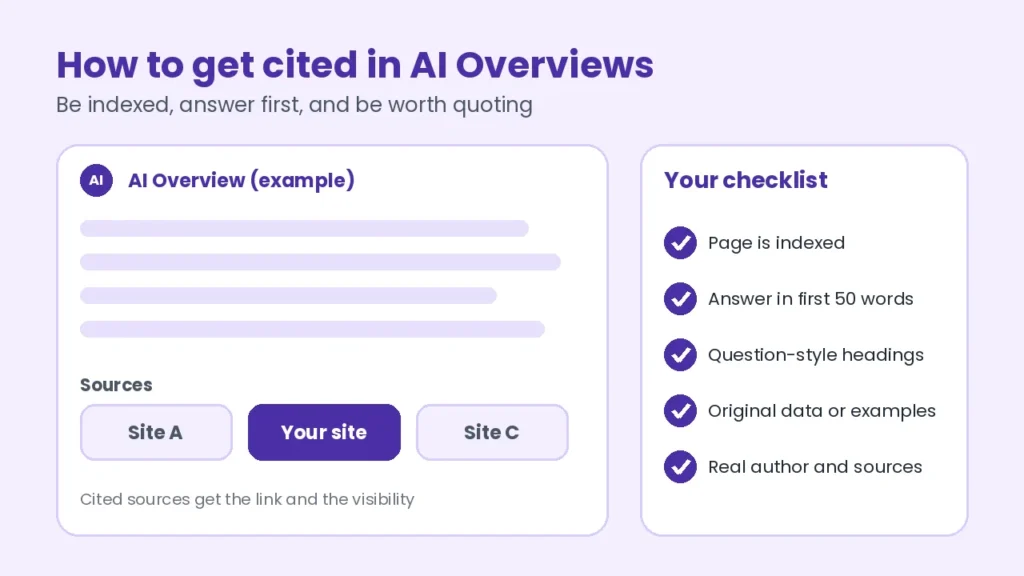
Learning how to get cited in AI Overviews has become a priority for anyone who depends on Google traffic. AI Overviews are the AI-generated summaries that appear at the top of many Google searches, with links to the pages the answer draws on. Being one of those linked sources can bring visibility and clicks that a normal blue link might not. This guide explains what Google says about eligibility, gives nine practical steps that suit small websites, shows how to fix the most common problems, and explains how to track whether you are being cited. There is no secret trick, but there is a clear order of work.
Quick answer: To get cited in AI Overviews, make sure your page is indexed and eligible to show a snippet, answer the question clearly near the top, add original information that other pages lack, structure the page with question-style headings, show real authorship and sources, and earn mentions on other credible sites. Google says no special markup or file is required.
Key takeaways
- A page must be indexed and eligible to show with a snippet before it can be a supporting link in Google’s AI features.
- Clear answers, original information and credible authorship are what repeatedly come up as the foundations, and they are also classic SEO good practice.
- Estimates of how often AI Overviews appear vary widely between studies, so treat statistics as directional.
- Track citations manually with a fixed list of questions, because no tool gives a perfect picture.
Why this matters in 2026
Search behaviour is shifting. Chartbeat data reported by the Reuters Institute found that Google search traffic to more than 2,500 news sites fell 33% globally, and 38% in the United States, between November 2024 and November 2025. Publishers link that decline to AI summaries and zero-click behaviour, although causes are debated. Estimates of how often AI Overviews appear differ by study and date: Semrush data cited by SEO publications showed coverage rising from about 6.5% of queries in January 2025 to near 25% in July 2025 and settling below 16% by November 2025, while other 2026 analyses report much higher figures for some query types. Methods, keyword sets and timing explain much of the gap.
What every source agrees on is the direction of travel: more answers appear before the click, and being named as a source is increasingly part of visibility. For our wider view of this change, see what is now replacing SEO.
What is an AI citation?
In Google’s AI Overviews and AI Mode, the generated answer is accompanied by links to supporting web pages. Appearing in that list is what people mean by being cited. Other assistants such as ChatGPT, Perplexity and Claude also cite or mention sources, but they use different retrieval systems. One 2026 study of repeated prompts reported that the brands recommended by ChatGPT and by Google’s AI Overviews overlapped very little, so you should not assume that visibility in one place carries over to another.
What Google says about eligibility
Google’s documentation on AI features and your website makes three points that shape the plan below:
- A page needs to be indexed and eligible to appear in Search with a snippet to be a supporting link.
- The same foundational SEO best practices apply. There is no special optimisation, markup or file required.
- Controls such as
nosnippet,max-snippetandnoindexaffect how or whether your content can be shown.
Everything else in this guide is practical advice drawn from that foundation and from patterns that practitioners report, so treat the specifics as informed guidance, not guarantees.
9 steps to get cited in AI Overviews
Step 1: Find the questions that trigger AI Overviews in your niche
Write a list of 20 questions your customers ask. Use Google autocomplete, People Also Ask and the Queries report in Search Console, filtering for queries that start with how, what, why, best, can or should. Search each one in a private window and note whether an AI Overview appears and which sites it links. This list becomes your tracking set in step 9. AI Overviews tend to appear on longer, question-style searches, so aim for specific questions rather than broad head terms.
Step 2: Make sure your pages are indexed
If a page is not in Google’s index, it cannot be cited. In Search Console, inspect your key URLs. If you see “Crawled – currently not indexed”, follow our guide to fixing crawled currently not indexed in WordPress. For new links and posts, see how to get backlinks indexed faster.
Step 3: Check that you are not blocking snippets or crawlers
- Confirm that robots.txt does not block Googlebot from the page.
- Look for
noindexandnosnippetin the page head or HTTP headers, and for restrictivemax-snippetvalues. - Make sure the main text is present in the HTML or rendered reliably, not hidden behind scripts or tabs that need interaction.
Step 3b: Fix any technical errors in the page
Pages that return errors, load very slowly or break on mobile are poor candidates for citation. Check Core Web Vitals in Search Console and fix the worst offenders first.
Step 4: Answer the question first, in plain words
Put a direct answer of about 40 to 60 words directly under the question-style heading or at the top of the page, then add detail. Use the same words as the question. For example, a heading such as “How long does a guest post take to be indexed?” followed by a clear two-sentence answer is easy for a system to extract and for a reader to trust. One analysis by AirOps reported that more than half of citations came from the top third of a page’s content, which fits the common advice to front-load the answer. Treat that as a useful pattern, not a rule.
Step 5: Add information that other pages do not have
AI systems summarise many pages, so a page that repeats the same generic points gives them no reason to pick it. Add something specific:
- A first-hand test, with the method and the result.
- A worked example with real numbers or screenshots.
- A comparison table that makes a decision easier.
- A short checklist from real experience.
- A fresh statistic, with the source and date clearly named.
Be precise and honest. Specific, verifiable claims are more useful than vague ones, and unsupported claims damage trust.
Step 6: Structure the page so it is easy to extract
- Use one H1, then H2 and H3 headings phrased as the questions people ask.
- Use short paragraphs, numbered steps for processes and bullet lists for options.
- Define key terms once, clearly, where they first appear.
- Use tables for comparisons.
- Keep each page focused on one topic and link to related pages for the rest. See keywords vs topics in SEO.
- Keep structured data accurate and matched to visible content. It can help systems understand a page, but it is not a guarantee of citation.
Step 7: Show real authorship and trust signals (E-E-A-T)
Add a named author with a short bio that explains why they are qualified, a published and reviewed date, links to primary sources and clear About and Contact pages. E-E-A-T (Experience, Expertise, Authoritativeness, Trustworthiness) is a quality framework, not a score you can switch on. But it describes what people and systems look for when deciding whom to trust.
Step 8: Earn mentions on other credible sites
AI answers often reflect what the wider web says about a topic and a brand. Being mentioned or linked on relevant, reputable sites, such as industry publications, partners, local organisations and respected blogs, supports both rankings and the likelihood of being treated as a trusted source. Start with free methods in how to get high-quality backlinks for free. If you use paid placements, make sure they are relevant, disclosed properly and safe. Read how to buy guest posts and how Markwood works. Remember that links on some platforms are nofollow, which still helps with visibility. See the nofollow link definition for how that works.
Step 9: Refresh, then measure with a fixed prompt list
Each month, repeat your 20 questions in a private window. In a spreadsheet record whether an AI Overview appeared, whether you were cited, who else was cited and how the answer is worded. Update pages that are missing or out of date. Remember that results vary by location, time and wording, so look for trends over several months, not single results. Google has said that traffic from AI features is counted within Search Console’s overall web search data, so you cannot isolate it there. Use Search Console to watch impressions and clicks for your question-style queries, and use your prompt list for citation tracking.
Quick checklist
| Check | Why it matters |
|---|---|
| Page is indexed | No index, no citation |
| No noindex, nosnippet or blocked crawling | Controls can stop content being shown |
| Answer in the first 40 to 60 words | Easy to extract and to trust |
| Question-style headings | Matches how people ask |
| Original examples, data or tests | Gives a reason to choose your page |
| Named author, date and sources | Supports trust |
| Mentions on other credible sites | Builds authority beyond your own pages |
| Monthly prompt tracking | Shows what is actually working |
Common problems and how to fix them
Problem 1: You are never cited for any question
Fix: Start with eligibility. Check indexing, snippets and technical errors. Then compare your page with the cited pages: what do they say, show or prove that you do not? Add a direct answer, original information and clearer structure.
Problem 2: You rank on page one but are not cited
Fix: Ranking and citation overlap but are not identical. Rewrite the top of the page so that the answer is explicit, add a table or list that summarises it, and improve trust signals. Make sure the page answers a more specific version of the question than competitors do.
Problem 3: You are cited but get few clicks
Fix: Citations give visibility, but the summary may satisfy the reader. Give people a reason to click: a tool, template, calculator, deeper example or comparison that the summary cannot replace. Also strengthen your brand so that people recognise and search for you directly.
Problem 4: The AI summary gets facts about your business wrong
Fix: Publish a clear, accurate page that states the facts: what you do, where, for whom, pricing approach and contact details. Make them consistent across your site, profiles and directories. Use the feedback option in the search result where available, and keep your pages updated.
Problem 5: Competitors are cited because they are mentioned elsewhere
Fix: Build real third-party presence. Contribute useful guest content to relevant sites, take part in industry discussions honestly, and earn mentions through original data or tools. Avoid fake reviews and spammy comments, which can backfire.
Problem 6: Traffic has fallen since AI Overviews expanded
Fix: Separate the cause. Check whether lost clicks come from queries where AI Overviews appear, or from ranking drops. Shift effort towards queries that need depth, comparison, tools or local action, and towards building a recognisable brand and email or community audience. See SEO tips for 2026 for the broader plan.
Myths to ignore
- “You need a special file or markup.” Google’s documentation says that no special optimisation is required for its AI features.
- “More pages means more citations.” Volume of thin pages is more likely to cause indexing problems.
- “Stuff the question in every heading.” Natural phrasing that matches the reader’s question works. Repetition does not.
- “Mass-produced AI text will win.” Unreviewed, generic text adds nothing new and often fails indexing quality checks.
- “Buy lots of cheap links.” Relevance and trust matter far more than volume.
How this connects to E-E-A-T, AEO and GEO
- AEO (Answer Engine Optimisation) is the practice of structuring pages so that questions are answered clearly and early. Steps 4 and 6 are AEO.
- GEO (Generative Engine Optimisation) is the practice of being understood, trusted and cited in AI-generated answers. Steps 1, 8 and 9 sit here, and they extend beyond Google to other assistants.
- E-E-A-T runs through all of it: first-hand experience, expertise shown through details, authority from reputable mentions and trust from transparency. Step 7 is its practical form.
Frequently asked questions about how to get cited in AI Overviews
How do I get my website cited in Google AI Overviews?
Make sure your page is indexed and snippet-eligible, answer the question clearly near the top, add original information, show authorship and sources, and earn mentions on other credible sites.
Do I need to rank in the top 10 to be cited?
Strong rankings help, but cited pages do not always come from the top 10 and studies differ on the overlap. Focus on being indexed, relevant and clearly the best answer to a specific question.
Does schema markup help with AI Overviews?
Accurate structured data can help systems understand a page, but Google says that no special markup is required, and it is not a guarantee of citation.
Can I see AI Overviews traffic in Search Console?
Google has said that traffic from AI features is included in overall web search data, so it is not reported separately. Track your own prompt list alongside Search Console.
Is getting cited in AI Overviews the same as ranking in ChatGPT?
No. Different systems use different sources and retrieval methods. A solid SEO foundation helps in all of them, but each can return different citations.
How long does it take to get cited?
There is no fixed timeline. Indexing changes can show within weeks, while building authority and mentions takes months. Measure monthly and adjust.
Conclusion
How to get cited in AI Overviews comes down to being eligible, being clear and being worth quoting. Fix indexing first, answer questions directly, add something only you can offer, show who stands behind the page and earn credible mentions elsewhere. Track a fixed list of questions every month and improve what is missing. These steps also strengthen your ordinary SEO, so the work pays off even where AI Overviews do not appear.